Overview
ARM is short for Association Rule Mining. This is a widely-used method for finding unique patterns or associations between items in large transactional datasets, such as data from what customers purchased at a store. For example, a use case of ARM might be to find if there is any support for the claim that, if a customer buys milk at a store, that they will also buy bread.
Rules are discovered truths about the dataset in question. They are typically written X → Y, where X and Y are different itemsets. The rule above would indicate that a customer who bought item X is likely to buy item Y. The threshold for determining whether a likelihood becomes a rule is arbitrarily chosen.
Support is a measurement used in ARM, representing how likely it is that an item will be found in the dataset. For example, a support for X of 40% means that 40% of all transactions in the dataset contain item X.
Confidence is used to describe rules, and gives the probability that a transaction containing X will also contain Y. Mathematically, it is described as follows:
confidence(X → Y) = {support(X U Y)}/{support(X)}
If confidence is high, then there is a high likelihood of finding Y where we find X.
Lift is a measurement, again, describing rules, that measures how much more likely it is that transactions that contain X will contain Y compared to a random transaction in the dataset. Mathematically, it is described as follows:
lift(X → Y) = {support(X U Y)}/{support(X) * support(Y)}
A lift greater than 1 indicates that X and Y appear more often than it would be expected that they would appear together if they had no relation to each other. A lift less than 1 indicates the opposite; that X and Y appear together less often than would be expected. A lift equal to 1 indicates that there is no relationship between X and Y.
The Apriori algorithm is a way to conduct frequent itemset mining. This is the first step before finding interesting rules. It works by finding all unique items in a dataset, then checking which of these meet a minimum support threshold (arbitrarily determined). We designate these as frequent-1-itemsets. From these, we generate candidate k-itemsets from the (k-1)-itemsets. For example, if {milk} and {bread} are both frequent-1-itemsets, then we would combine them to form a candidate 2-itemset {milk, bread}.
We then use the principle called the Downward Closure Property, that states that all non-empty subsets of a frequent itemset must also be frequent. This means that if {milk, bread} is frequent, then {milk} and {bread} must also be frequent. If, for example, {milk} is not found to be frequent, then checking {milk, bread} is unnecessary. We use this property to prune our options by deliberately not checking any itemsets that could not, by the Downward Closure Property, be frequent.
For each candidate k-itemset, we scan the entire dataset to count the number of transactions containing this set. Any candidate k-itemset that does not meet the arbitrarily defined minimum support threshold is pruned and discarded. For every iteration of the algorithm, k increases by 1. The algorithm stops when no candidates meet the minimum support threshold and no more frequent k-itemsets can be found.
From each frequent itemset that the algorithm finds, we create rules. For example, if {milk, bread} is frequent, we consider rules such as {milk} → {bread} and {bread} → {milk}, as long as they meet the minimum confidence threshold.
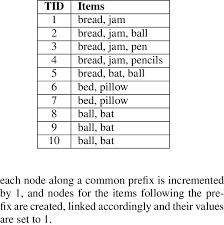
This image shows an example of a transactional dataset
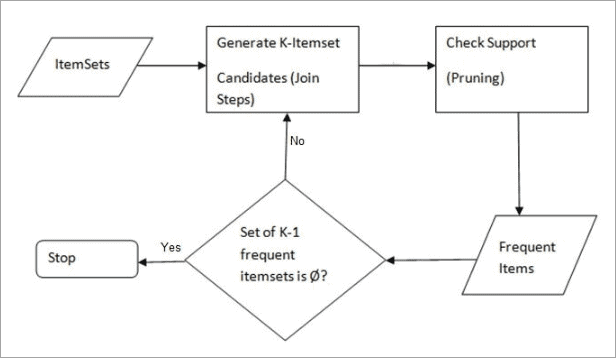
This is an image detailing the steps of the Apriori algorithm described above.
Data Prep
As explained above, transactional data only shows items that were purchased in a single transaction, without including item quantities or any other information. In the case of this project, fortunately the number of active traits used by a player in a particular game can be transformed into transaction data. We can then perform ARM on this data to find if there are any traits that are frequently used together by players.
Below is a snippet of our trait data transformed into transactional data.
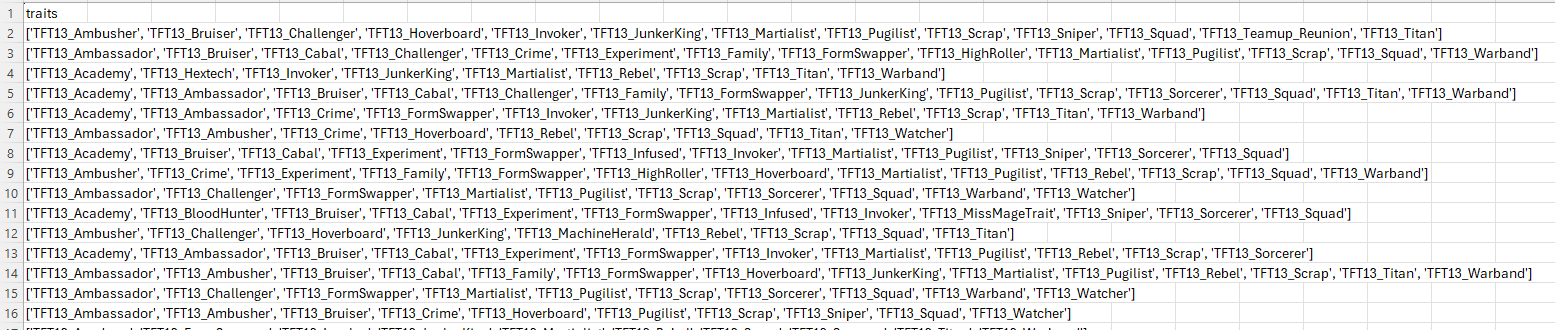
This is an image showing a snippet of transactional trait data. Every "transaction" is the traits used by one player in a particular game.The full dataset can be found here: Data
ARM Code Found Here: Code
Results
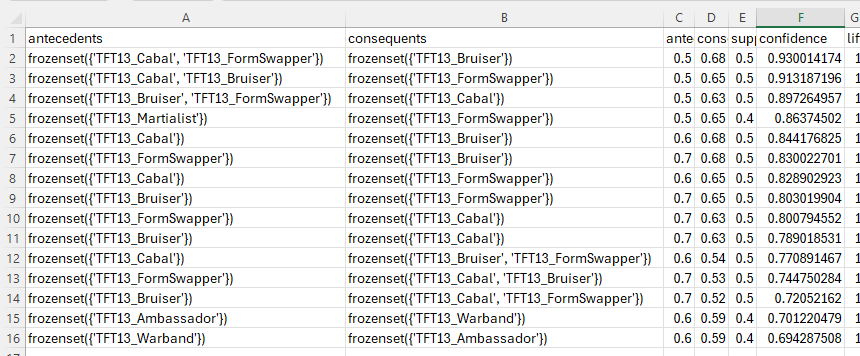
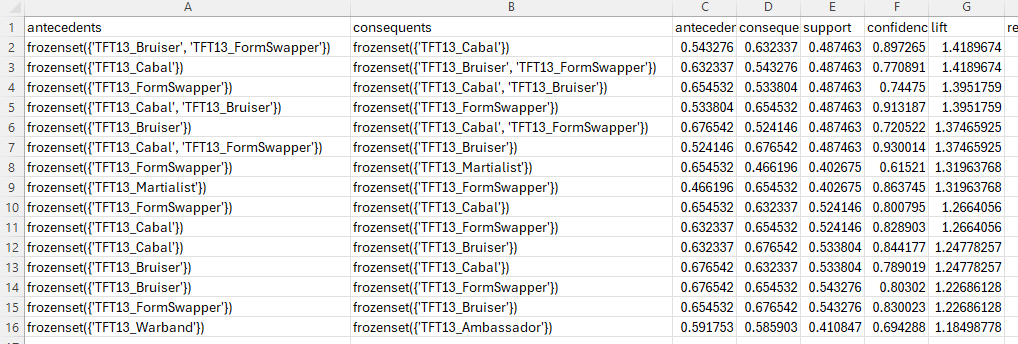
The following images show the Top 15 rules found through ARM based on the metrics of support, confidence, and lift. The minimum support threshold and confidence threshold were both defined as 0.4, as this was the smallest threshold that generated at least 15 rules.
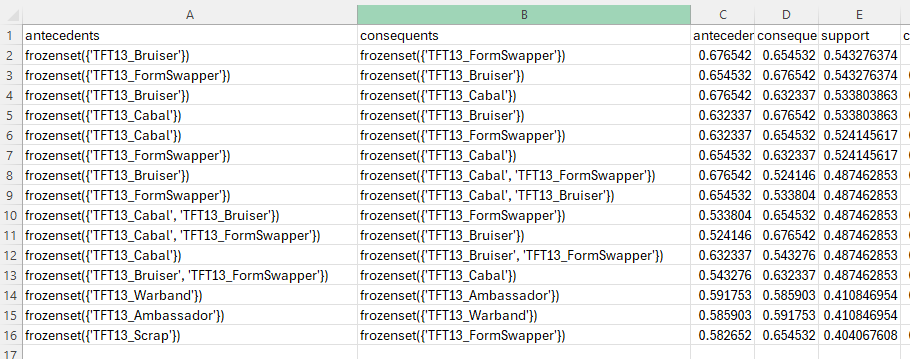
This snippet shows the top 15 rules based on their support metric (note the support column values on the right)
This snippet shows the top 15 rules based on their confidence metric (note the confidence column values on the right)
This snippet shows the top 15 rules based on their lift metric (note the lift column values on the right)
The traits Bruiser, FormSwapper, and Cabal all seem to be highly associated with each other no matter which metric is used.
The below image is a visualization of the network of associations found with ARM. We can see more clearly the concrete rules that we found. Bruiser is associated with Cabal and Formswapper, Formswapper is further associated with Scrap and Martialist. Unassociated with any of these is the separate association of Ambassador and Warband.
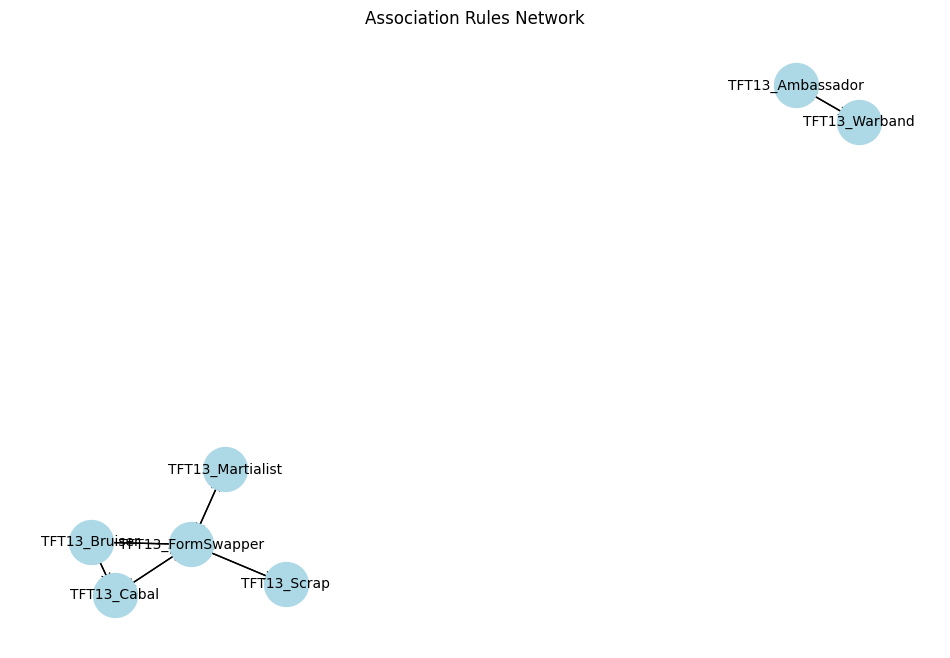
This visualization shows all the association rules found through mining
Conclusions
We were able to create a dataset of “transactions” that contained traits used by any one player in a particular match of TFT, and through this data we were able to find solid association rules between some traits, as mentioned above in the Results section. These rules indicate traits that are frequently found together on one player’s board in a game of TFT, and can give insight into common strategies players were using at the time the data was retrieved. In other words, players seem to often have units with the Bruiser trait and units with the FormSwapper trait on the same board, likely indicating that there is a strategic value in doing so, especially when considering the high rank of the players whose data has been analyzed. More analysis could be done to determine if these association rules also correlate with higher placement within a game. ARM has provided unique computationally-based insight into strategies adopted by TFT players.