Decision Trees
Overview
This algorithm is named for its shape, and appears like an inverted “tree” with branches “growing” from a single point, which we call a root. Each splitting point in the tree is called a node. At the root node, a question is asked about the data. For example, we might have a question about classification in regards to a dataset, such as: “does a data point classified as a ‘1’ have more or less of a certain feature than a specified attribute?”, or: “does a data point classified as a ‘0’ contain a certain feature, or does it not?”. An initial question like this is asked first at the root node, and depending on the value of any data point, we will follow down one “branch” of the tree if the answer is yes, and a different branch if the answer is no (trees may have more than two branches leading from any node, but for simplification, simply imagine two branches from any single node in the tree). After answering this question, further nodes down the tree specify which data point we have and where it will fall based on answers to more and more specific questions. Finally, at the bottom of the tree, we reach a “leaf” node - there are no more nodes to follow when we reach a leaf, and the leaf we reach tells us how we may classify our data point in question.
The decision tree is trained on data for which we already have classification labels - the model examines each point of training data and discovers what value thresholds of certain features determine whether a data will be classified into one category or another. The algorithm scans a series of candidate thresholds for each feature in the dataset, looking for what will best separate classes. It examines a series of candidates for where to split groups of data into two (at each level of the tree), and computes an impurity score, using either the metric of Gini or Entropy. A Gini impurity score measures how likely a randomly chosen element will be misclassified within a set (in this case, out of all data that will be split by a node), while an Entropy score is a more precise measure of randomness within a set, and tells us how much information is required to determine a class for a data point. The goal in using either of these two metrics is to measure information gain, which is the amount the “impurity” of a node will decrease after splitting. The goal is to maximize the information gain by ensuring that the amount of disorder lost by each split is maximized, and that each subsequent node is more and more “pure”. Gini is a good metric to use if we care more about the speed of the algorithm, while Entropy is a more precise metric but takes longer to calculate. The tree is trained when it has identified all splits and nodes, and the depth of the tree has been found such that each leaf node (and each split along the way) is as pure as possible.
After training, the model is given new data and bins it according to the features it has and how they correspond to the splitting decisions the tree has already found. This step is done extremely quickly, since no further calculations need to be done, and each new data point can simply flow down the tree until it is binned by a leaf and classified (note that it is also possible to use decision trees to find continuous values).
Data Prep and Code
CODE FOR ALL PROCESSES EXPLAINED BELOW CAN BE FOUND HERE: DT CODE
To create data suitable for training and testing of three different Decision Tree models, data was prepared from three different datasets. The first dataset contained data on gold remaining for a player in a match at the time of elimination. The second dataset contained information on which traits were fielded and with how many units per trait for a player in a match, and the third dataset contained information on specific units fielded by a player in a match at the time of elimination.
These three datasets were combined, cleaned, transformed, and then separated into training and testing sets suitable for each tree. The dataset designed to be used for the first decision tree model was obtained by combining information from the original 1st and 3rd datasets mentioned above. This dataset contains information on gold remaining, the sum of the tiers of all units fielded by a player, and the mean rarity of units fielded by that player (all at time of elimination). This data was divided into training and testing sets in an 80%/20% split, as seen by the images and links below:
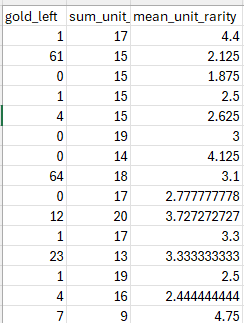
Training Data. Full Dataset can be found here: Training Dataset
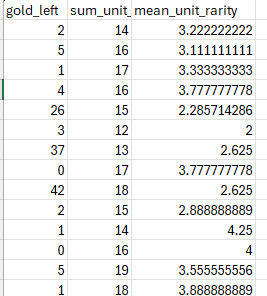
Testing Data. Full Dataset can be found here: Testing Dataset
The dataset to be used for the second DT model is identical to the data used to train our Naive Bayes model (explained here), and contains data on which traits were fielded by a player in a match at the time of elimination, as well as the number of units corresponding to each trait. Note that this dataset contains information on whether or not a player “podiumed” or not (placed within the top 4 players), instead of exact placement data. This data was also divided with an 80%/20% split for training and testing, respectively. Images of snippets of training and testing datasets, as well as links to full datasets, are below:

Training Data. Full Dataset can be found here: Training Dataset

Testing Data. Full Dataset can be found here: Testing Dataset
The final dataset, used for our final DT model, contains binary information on whether or not a particular unit was fielded by a player at the time of their elimination. Again, this data was divided into training and testing sets with an 80%/20% split. Image snippets of training and testing data, as well as links to full datasets, are below:

Training Data. Full Dataset can be found here: Training Dataset

Testing Data. Full Dataset can be found here: Testing Dataset
Results and Conclusions
Decision Tree 1
Below is a visualization of our first decision tree:
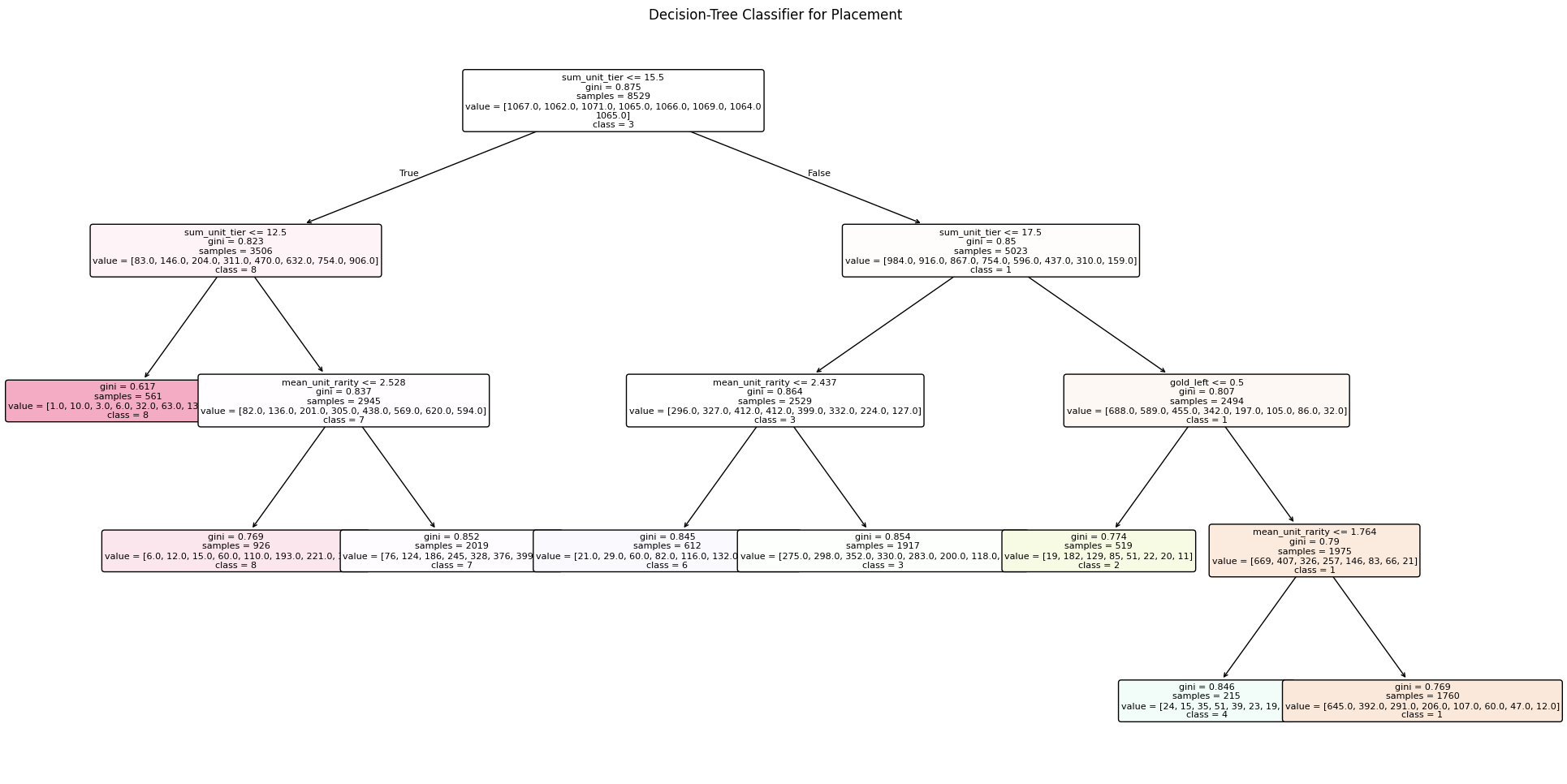
This decision tree classifies player placement based on the sum of their unit tiers, their mean unit rarity, and their gold remaining.
The below image shows our accuracy score for this decision tree as well as the confusion matrix:
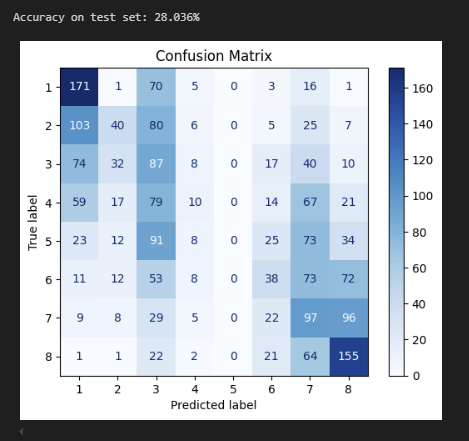
We see a very low accuracy score along with a confusion matrix. Note the dark colors at the top left hand corner and the bottom right hand corner of the matrix.
Looking at the tree itself, we can see that the largest split (at the root node) shows us that the most important determiner for predicting placement is the sum of unit tiers. The second most important feature is mean unit rarity. Gold remaining only appears to matter on the high-tier side of the tree.
With an extremely low accuracy of only 28% on the testing set indicates that our tree is very unreliable at predicting player placement from the three metrics of gold remaining, sum of unit tiers, and mean unit rarity. The one silverlining is that recall scores (calculated by dividing the true positive prediction rate by the row total in the confusion matrix) for placements of 1 and 8 are relatively high, being 0.64 and 0.58, respectively. This indicates that the tree does a decent job at predicting if a player will place first or last, but not a good job at predicting how well a player will place in between these classes. Note the tree cannot identify a player that placed 5th correctly at all. The code (linked above) shows that the maximum leaf nodes of this tree were limited to no more than 8 - this was done for simplicity’s sake and to limit the tree’s complexity (hyperparameter tuning showed that increasing this number did not significantly improve accuracy). Further adjustment of hyperparameters, as well as inclusion of more features, would be good first steps to try and improve accuracy of this decision tree.
Decision Tree 2
Below is a visualization of our second decision tree:
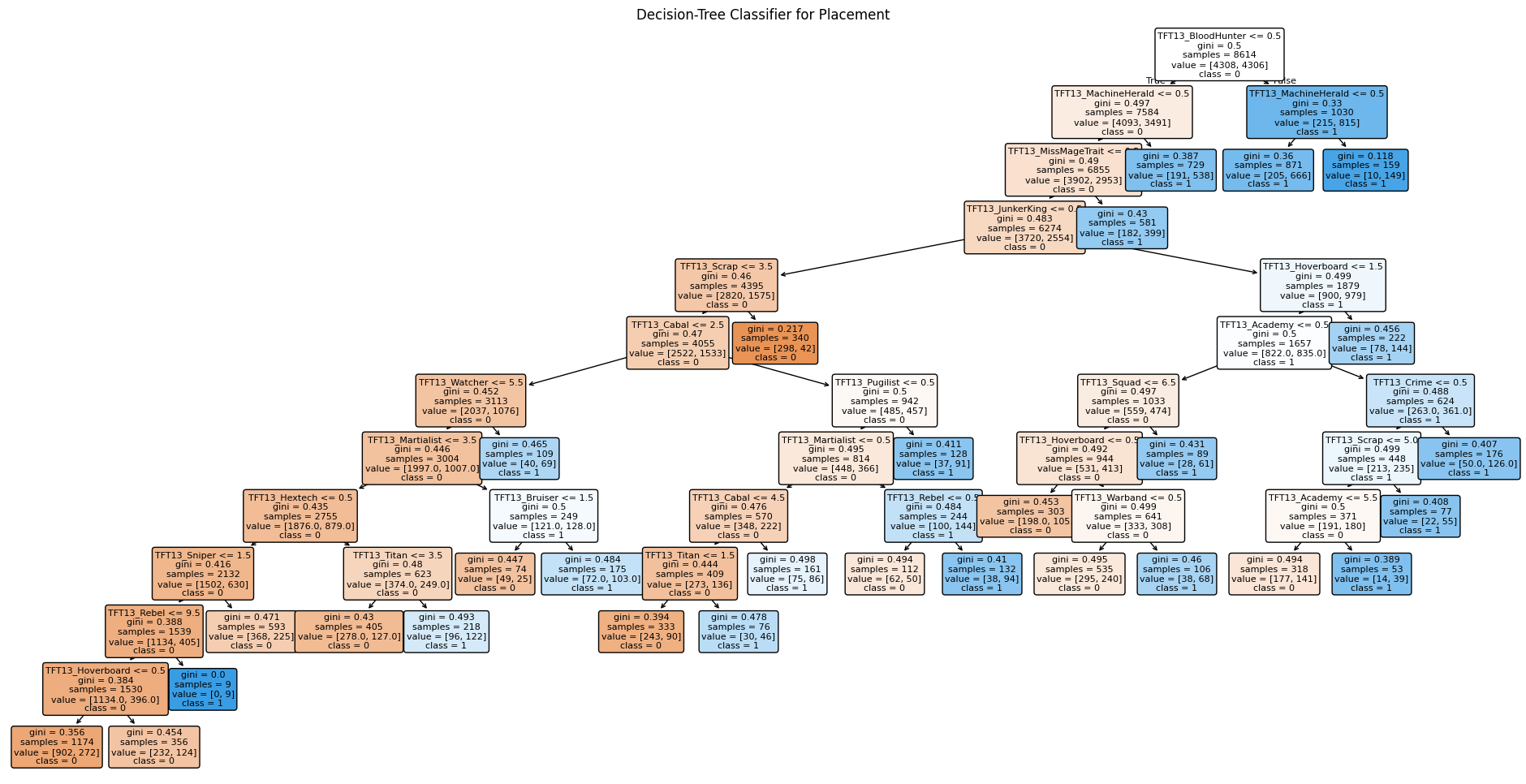
This decision tree classifies player placement based solely on the traits they fielded and the number of units in each trait. Note that this tree only classifies whether players placed in the top 4 or not, and does not try to predict specific placement.
The below image shows our accuracy score for this decision tree as well as the confusion matrix:
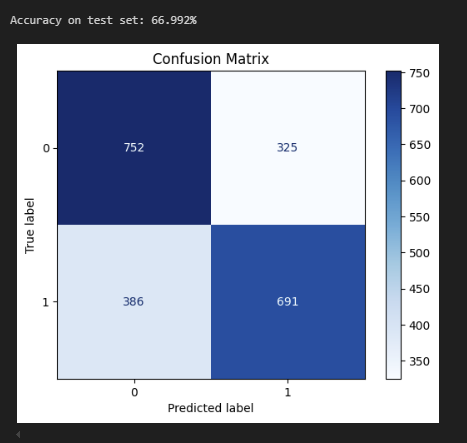
We see a decent accuracy score along with a simpler confusion matrix
This tree is more complex due to the max leaf nodes being increased to 29 (again, this hyperparameter was adjusted and could not be improved substantially by altering this number). However, note that there are only two classes for this tree’s predictions (1 if a player placed in the top four and 0 otherwise). We see the root node shows that the first split is whether or not a team contained the ‘BloodHunter’ trait, and every subsequent node shows a different trait and/or values for that trait that are important in determining placement. The tree effectively shows which traits synergize well. Bloodhunter is the most important trait towards determining a top-four placement. If Watchers is run, it is also imporant to have Martialists, or else one can likely expect poor performance, for example.
The accuracy score of almost 67% shows substantial improvement over our first decision tree model. However, 1 out of every three data points are still misclassified by this model. This improvement in performance is likely due largely to the fact that we are only predicting binary performance and not trying to find specific placement, which is a more difficult task. Allowing a larger tree would likely help (at the cost of interpretability), and of course adding richer features may also go a long way to improving accuracy.
Decision Tree 3
Below is a visualization of our third and final decision tree:
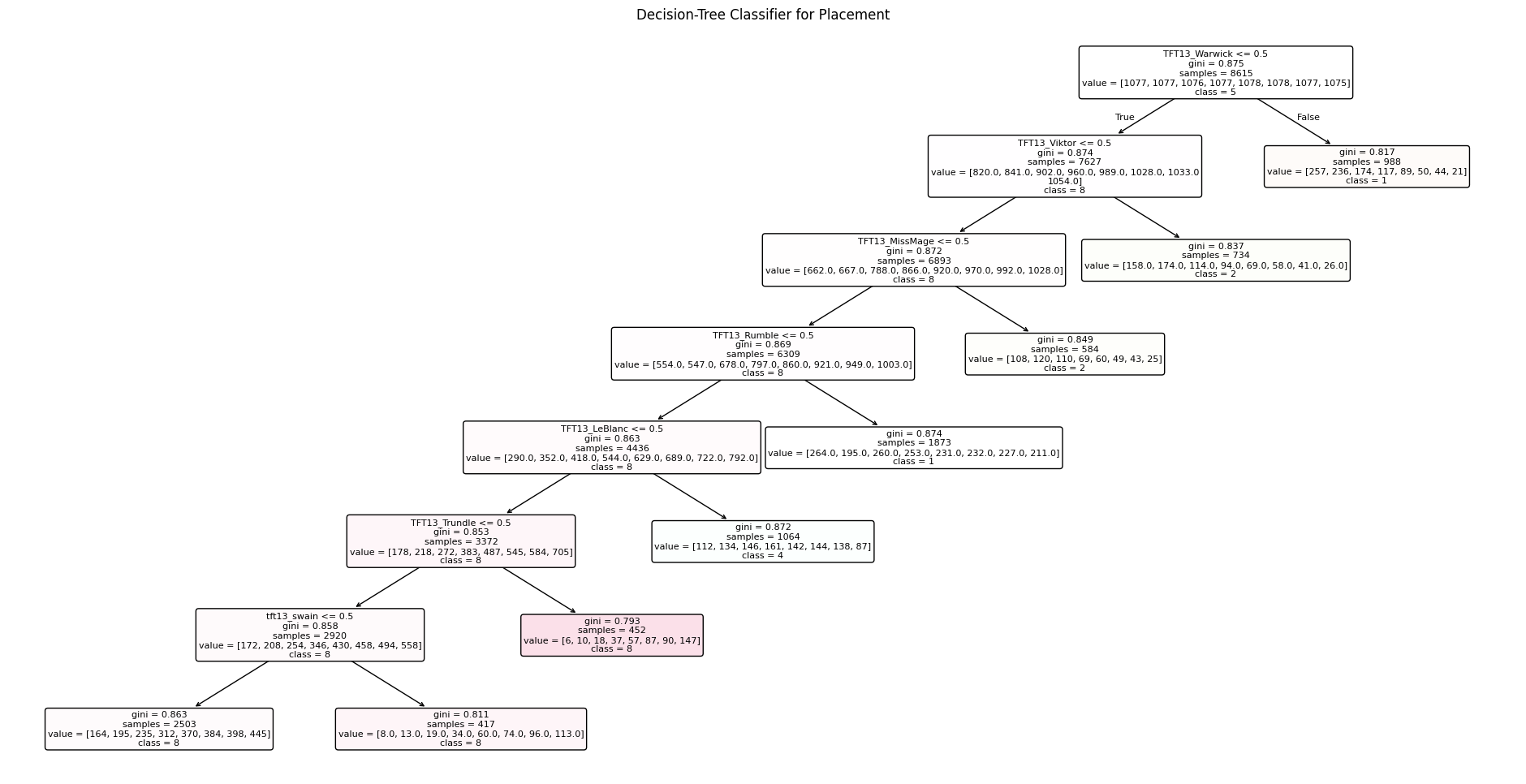
This decision tree classifies player placement based only on the units they fielded. This tree, like our first, tries to predict placement.
The below image shows our accuracy score for this decision tree as well as the confusion matrix:
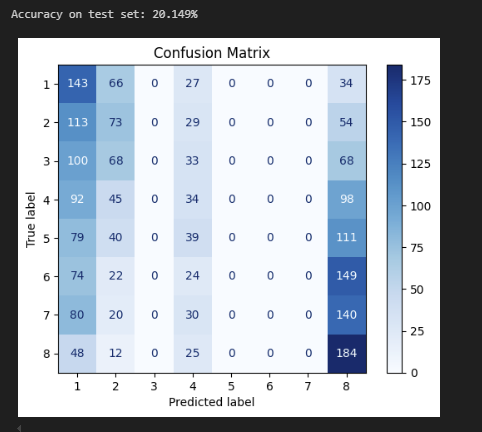
We see a very low accuracy score and a complex confusion matrix. Again note that the darkest colors are either in the top left or the bottom right of the matrix, signifying that the tree is most accurate at predicting either first or last place, but is very inaccurate otherwise.
This tree is capped at 8 leaves (again, hyperparameter tuning did not significantly improve accuracy score). Note that many placement classes (3, 5, 6, and 7) do not even have a leaf, and are never predicted by the model. The root node splits at Warwick, indicating that this is the most important unit in terms of predicting placement - boards without Warwick tend to place low. Boards without Warwick and Victor tend to place last overall. A common success pattern appears to be Warwick, Viktor, MissMage and Rumble together, which commonly shows a first place victory. These are valuable insights to predicting first and last place finishes even if the model is extremely weak at predicting any placements in between.
The accuracy score of the tree overall is about 20%, meaning it is only marginally better than randomly guessing placement, unfortunately. We see the highest recall score and the darkest color in the confusion matrix at the bottom right hand corner (recall of 69% for 8th place), indicating that the tree is best at spotting boards that will place last. Every other placement prediction is likely to be untrue. Adding leaves to the tree, adding more information for the tree to learn from, and adjusting more hyperparameters so the tree can make smarter split decisions could all potentially improve this model.