PCA
Principal Component Analysis, or PCA, is a means by which to reduce the complexity of a dataset. Using sophisticated linear algebra and coding techniques, we can use PCA to eliminate unnecessary parts of our data that do not give us a lot of information. By using PCA as a statistical “editing” technique, we can learn which parts, or “dimensions” of our dataset summarize that dataset the best. Reduced datasets can often be easier to use to train machine learning models.
All code used can be found here: Code
Data
Before Cleaning
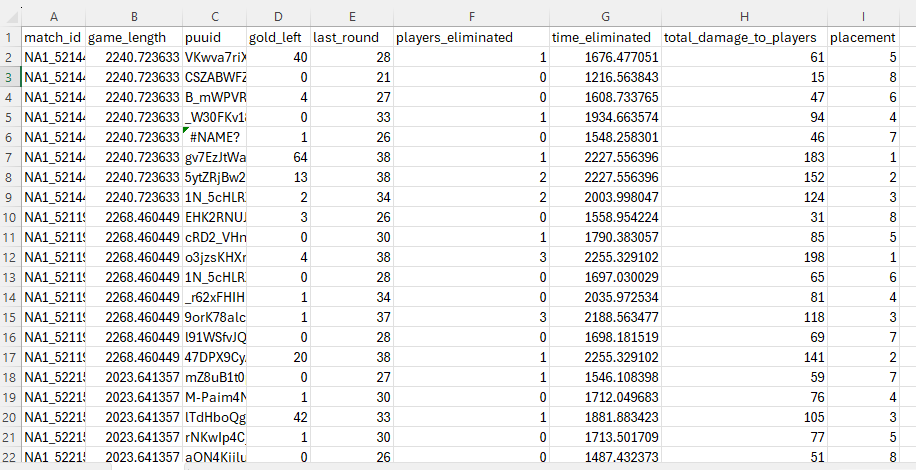
This is the data that PCA will be performed on, before cleaning. Note that the "label" in this case would be placement. Note also the many quantitative features. Time measurements (game length and time eliminated) are in seconds. Link to data: Pre-PCA Data
After Cleaning
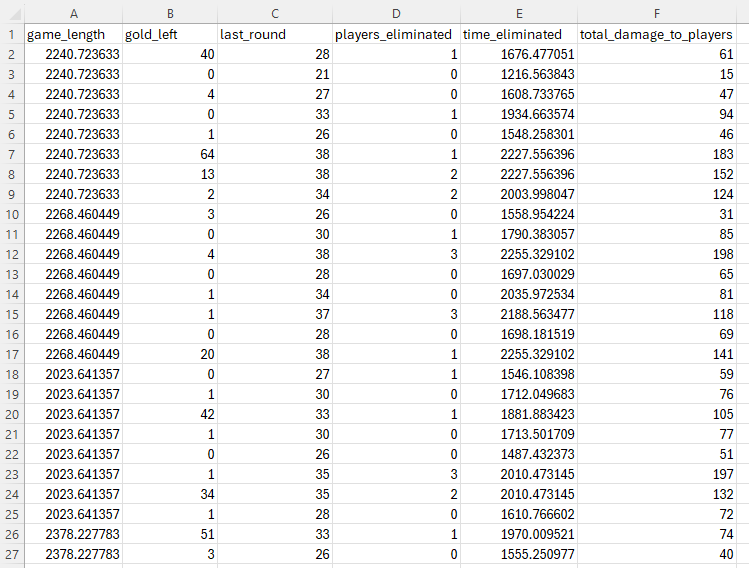
This is the data that PCA will be performed on, after cleaning. Note that the "placement" column has been removed, and both non-quantitative columns have also been removed. Link to data: Cleaned PCA Data
Visualizations of the Data
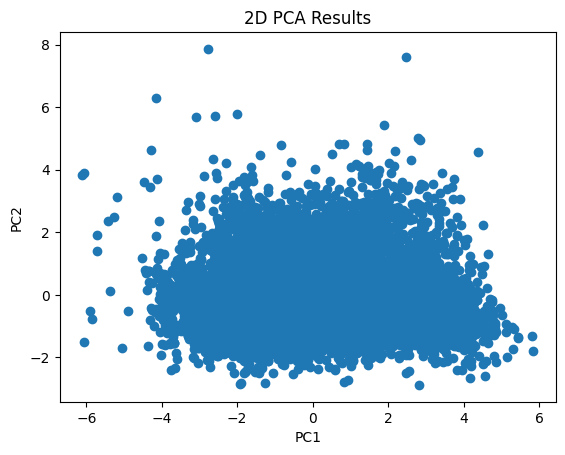
This is a scatterplot of the two principal components when PCA is performed on the data and the dimensions of the data are reduced to two. Note that data was scaled before PCA was performed.
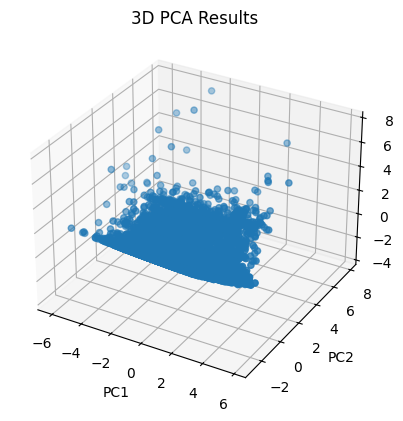
This is a 3D plot of the three principal components remaining when PCA is performed on the data and dimensions are reduced to three.
Information Remaining
When performing PCA in Python, we can output how much of the explained variance ratio is caputured by our principal components. This tells us how much of the total variance in the dataset is explained by each principal component. In other words, we can see how much information is retained when we reduce our dimensions. The image below shows how much of our information is kept by the principal components we have found for both two and three dimensions.
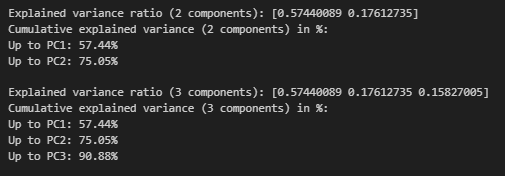
This is a screenshot of Python output showing how much of our explained variance ratio is explained by each Principal Component. We can see that the first principal component contains about 57.44% of the information we originally had in our full dataset. When we add the second principal component, cumulatively our dataset contains 75.05% of the information that it originally had. When we add a third principal component, our reduced dataset contains 90.88% of the information it had before conducting PCA.
Overall, 75.05% of the information remains in the 2D dataset, and 90.88% of the information remains in the 3D dataset.
If we want to increase our dimensions until we retain at least 95% of the original information, we would only need to add one additional principal component. The image below gives our cumulative explained variance ratio when we use PCA to get four principal components:

This is the output when we conduct PCA with 4 principal components. We can see that adding a fourth principal component means that 98.40% of the information from the original dataset is retained, which eclipses the goal of retaining at least 95% of the original dataset.
Eigenvalues
Eigenvalues are coefficients used as part of the linear transformation of the data during PCA. Essentially, they represent how much variance is in the data along each principal component. The largest eigenvalue explains the most variance, and is used for the first principal component, the second corresponds to the second principal component, and so forth. They are another way to express the amount of information we retain in the dataset by performing PCA. Below is an image showing our eigenvalues obtained through PCA and our top three eigenvalues:
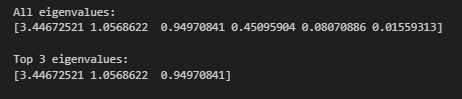
This is an image showing all eigenvalues obtained from PCA, and our top three by magnitude.